
Nepal sits at UTC+5:45, which puts it four hours and fifteen minutes behind Australian Eastern Standard Time. That single fact makes the Australia–Nepal pairing work better than most offshore arrangements, and it is almost never mentioned in the guides.
When your Sydney team starts at 9am, Kathmandu is at 4:45am — but by the time you reach 1pm, they have been working since 8:45 and have most of their day ahead of them. You get a genuine shared working window every afternoon without either side keeping unsociable hours.
We have delivered platforms for Australian organisations from Kathmandu, including an enterprise NDIS care platform and a website for an education and migration consultancy. This is the practical guide we wish had existed: the daily rhythm, the contract terms, the payment mechanics, and what to keep in-house.
The timezone maths
| Australian city | Offset from Nepal | Your 9am is Kathmandu | Practical shared window |
|---|---|---|---|
| Sydney / Melbourne (AEST) | +4h15m | 4:45am | Your 1pm–6pm |
| Sydney / Melbourne (AEDT, daylight saving) | +5h15m | 3:45am | Your 2pm–6pm |
| Brisbane (AEST year-round) | +4h15m | 4:45am | Your 1pm–6pm |
| Adelaide (ACST) | +3h45m | 5:15am | Your 12:30pm–6pm |
| Perth (AWST) | +2h15m | 6:45am | Your 11am–6pm |
Perth is the easiest pairing in the country — a two-and-a-quarter hour gap gives most of the working day in common. Sydney and Melbourne still get a solid four-to-five hour overlap every afternoon.
Two things to watch. Australian daylight saving shifts the gap by an hour from October to April in NSW, Victoria, SA, Tasmania and the ACT, while Nepal does not observe it — so your overlap moves twice a year. And Nepal’s public holidays differ substantially from Australia’s, with Dashain and Tihar in particular meaning extended closures in the September–November window. Ask for the holiday calendar before planning a launch.
A daily rhythm that works
The pattern most Australia–Nepal engagements settle into looks like this.
Your morning, their early hours. Nothing is expected of them. Use this to review what landed overnight, write feedback and unblock decisions. Anything you send now is waiting when they start.
Your midday, their morning. They pick up your feedback and start work. Questions begin arriving.
Your afternoon, their afternoon. The shared window. Put the standup here, and anything requiring live discussion. Keep it short and use it for decisions rather than status — status can be read.
Your evening, their evening. They wrap up and hand over in writing.
The discipline that makes it work: one written handover per day, from each side. What was done, what is blocked, what is needed. It takes ten minutes and eliminates most of the latency cost.
What breaks it: expecting instant responses outside the overlap, holding decisions until a live call, and having no single point of contact so questions bounce between people.
Contracts and IP assignment
Get four things right and the rest is manageable.
IP assignment, explicitly. The contract should state that all intellectual property created transfers to you on payment. Do not rely on this being implied — different jurisdictions treat commissioned work differently, and the default is not always what you expect.
Repository ownership. The strongest practical protection is structural: the GitHub, GitLab or Bitbucket organisation is on your account, and the vendor is granted access. Then ownership is not a clause to enforce, it is a fact.
The same goes for hosting, domains and cloud accounts. Your accounts, their access.
Confidentiality and data handling. If the work touches personal information about Australians, your obligations under Australian privacy law do not transfer offshore with the data. Specify where data may be stored and processed, who may access it, and what happens at the end of the engagement. For anything regulated — health, disability, financial services — put it in the contract rather than the kickoff call.
Governing law and dispute resolution. Name a jurisdiction. It rarely matters until it matters enormously.
Getting paid and paying
International bank transfer is the standard mechanism and established Nepali firms handle overseas invoicing routinely. Agree these in advance:
- Currency. Usually USD or AUD. Whoever is not billing in their own currency carries exchange risk — decide deliberately who that is.
- Who pays transfer fees. International transfers attract fees at both ends plus intermediary charges. Unspecified, this becomes a monthly irritation.
- Milestone schedule. Staged payments against deliverables protect both sides. Avoid paying everything upfront; avoid expecting a vendor to carry months of work unpaid.
- Invoice timing. Transfers can take several business days. Build that into your terms.
What to keep in-house
Offshore engineering works. Offshore ownership of the product does not.
Keep on your side: the decision about what to build and why; direct relationships with your customers; domain expertise, particularly anything regulatory; and final acceptance of whether work is done.
Delegate: implementation, technical architecture within agreed constraints, testing, and the engineering judgement about how to build what you have specified.
The engagements that fail are usually the ones where a client hoped to outsource product thinking along with development. A team eight thousand kilometres away cannot infer what your customers need. It can build extremely well against a clear specification.
On the NDIS platform, the regulatory knowledge sat with the provider who lived that world daily. Our side was the engineering discipline that knowledge demanded — audit trails, role-scoped permissions, data separation. Neither half would have produced a working system alone.
Two Australian projects, and how they actually ran
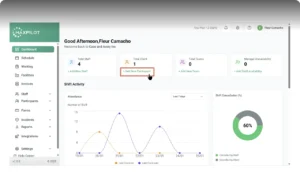
MaxPilot is an enterprise platform for Australian disability care providers, handling participant records, staff rostering, claims through PRODA and compliance documentation, with separate Admin, Manager and Staff dashboards. The compliance requirements shaped the architecture from the first schema rather than being added later — we wrote up the engineering lessons in building NDIS-compliant care software.
Moves International Australia is a website for an education and migration consultancy, built around university and course discovery, visa and migration information, appointment booking and enquiry capture, with a CMS structure the consultancy’s own team updates as programmes and intakes change. A very different build from MaxPilot, and a useful contrast: the hard part here was not compliance architecture but making information that students normally piece together from a dozen sources legible in one place.
What both had in common: a clearly specified domain, an Australian counterpart who owned the market and regulatory knowledge, written daily handovers, and a live overlap window used for decisions rather than status reporting.
Frequently asked questions
What is the time difference between Australia and Nepal?
Nepal is UTC+5:45, which is 4 hours 15 minutes behind AEST and 5 hours 15 minutes behind AEDT during Australian daylight saving. Perth is closest at 2 hours 15 minutes. Every Australian city gets at least four hours of natural overlap with a Nepali working day.
Do Nepali developers speak English well?
English is widely used in Nepali education and is the working language of the technology sector, so written English in the industry is generally strong. As with any cross-cultural team, the thing to manage is not vocabulary but directness — ask open questions rather than yes/no ones, and make it explicitly safe to disagree.
How do I handle Australian privacy obligations with an offshore team?
Your obligations remain yours regardless of where processing happens. Specify in the contract where data may be stored, who may access it, and what happens to it at the end. For regulated sectors, consider keeping production data onshore and giving the offshore team anonymised or synthetic data to develop against.
What about Nepali public holidays?
They differ substantially from Australia’s, with the Dashain and Tihar festival period between roughly September and November meaning extended closures. Request the holiday calendar at the start of the engagement and plan launches around it.
Is it cheaper than hiring in Australia?
Substantially on the hourly rate — offshore rates typically run $15 to $50 per hour against $80 to $150+ for Australian engineers. The net saving is smaller once you account for your own management time and specification effort, but it remains significant. The fuller comparison is in offshore development rates: Nepal vs India vs Vietnam.
How do I start without committing to a large project?
Run a paid pilot. Two to three weeks of real, scoped work tells you more about communication, code quality and reliability than any proposal or reference call. Make it something genuinely useful so the money is not wasted if you do not continue.
Working out whether this fits
The Australia–Nepal pairing suits organisations that want a small senior team rather than a large one, that can specify clearly, and that value continuity over the ability to scale headcount quickly. It suits less well if you need same-day turnaround across your whole working day, or a very large team at short notice — we covered those limits honestly in the rates comparison.
If you are weighing it up, tell us what you are building. We will give you a straight read on fit, including when the answer is that you should hire locally.