
Software for NDIS providers looks, from the outside, like a rostering app with some paperwork attached. It is not. The compliance obligations reshape the data model, the permission system and the audit strategy — and if you discover that late, retrofitting it is brutal.
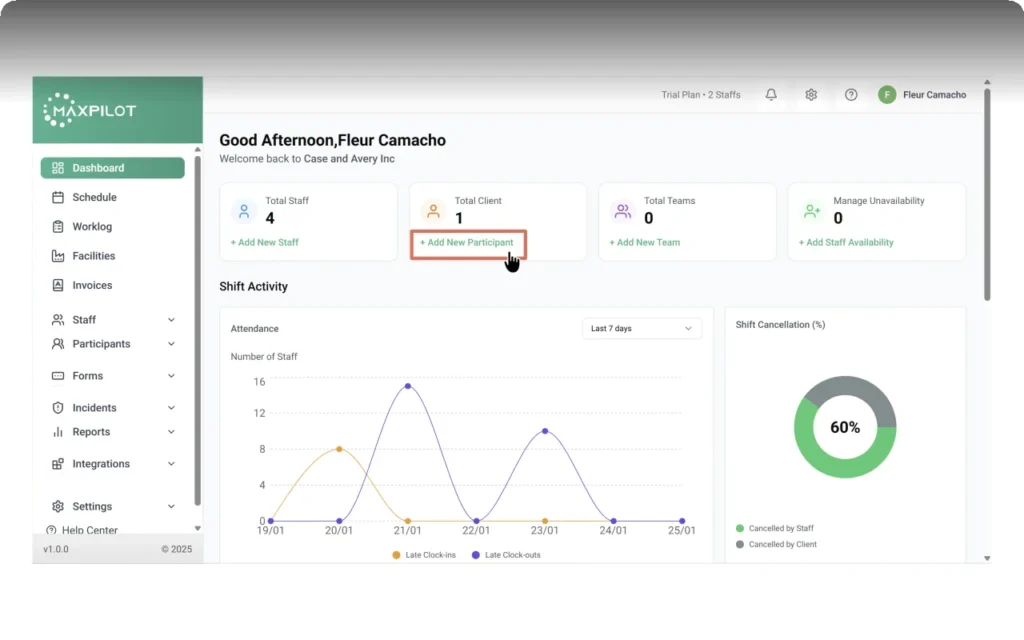
Shailee helped build MaxPilot, an enterprise platform for Australian disability care providers that brings participant records, staff operations, scheduling, claims and compliance into one system. This is what we learned about the engineering decisions that matter, written for the people who have to make them.
What NDIS compliance actually demands of software
The National Disability Insurance Scheme is administered in Australia with providers regulated by the NDIS Quality and Safeguards Commission. For a software team, three consequences follow, and each one is an architectural decision rather than a feature.
Records must be accurate, complete and retrievable. Not “stored” — retrievable, in a form that stands up to review. That means append-only history on anything material, not overwriting rows.
Participant information is highly sensitive. Disability care records combine health information, personal circumstances and financial data. Access must be scoped to what a role genuinely needs, and you must be able to demonstrate that scoping after the fact.
Claims flow through government systems. Providers submit claims via the NDIS provider portal, accessed through PRODA, the Australian Government’s Provider Digital Access authentication service. Your software does not own that pipeline; it has to work reliably against a system you do not control.
None of this is exotic. What makes it demanding is that all three apply simultaneously to the same records.
Participant data: model it for privacy from the first schema
The instinct on any care platform is one big participant record holding everything. It is the wrong shape for regulated data.
A support worker arriving for a shift needs the participant’s name, the address, the tasks for that shift and any safety-critical information. They do not need funding details, plan budgets, historical incident reports or contact details for every family member. If all of that lives on one object and access is filtered in the presentation layer, then every new screen, every export and every API endpoint is a fresh opportunity to leak it.
Separate the concerns in the data model itself — care-delivery information, administrative and financial information, and clinical or incident history as distinct entities with their own access rules. It costs more up front. It means that when someone builds a new report in eighteen months, the sensitive fields are not sitting there by default waiting to be included by accident.
Two related decisions worth making early: store an explicit consent and relationship model for who may see what about a participant, and design your soft-delete strategy deliberately. Care records generally cannot simply be deleted, so “removed from view” and “erased” must be different operations with different permissions.
Rostering and scheduling: where builds go wrong
Scheduling looks like a solved problem until you build it for care.
A shift is not just a time block with a person attached. It carries a participant with specific needs, a worker who may require particular skills or gender matching, a location, a travel component between appointments, and a funding line that determines whether the work is claimable at all. Change any one and the others may become invalid.
The mistakes we would warn any team about:
- Treating a shift as a single mutable row. When a shift is moved, shortened or reassigned, you need the history — because the claim, the pay and any later query all depend on what actually happened rather than what was last saved.
- Ignoring the gap between rostered and delivered. The scheduled shift and the shift that occurred are different facts. Conflating them makes claims wrong and audits painful.
- Underestimating recurrence. Care schedules repeat, and then they break — public holidays, leave, a participant in hospital. An exception model that cannot represent “this recurring shift, but not on that date, and different on this one” will be worked around manually, which defeats the system.
- Forgetting the field. Support workers are not at desks. If checking a roster or completing a form requires a laptop, the records will be written from memory hours later, and accuracy dies there. MaxPilot’s dashboards are responsive precisely so staff can work from a phone in the field.
Claims: build for the failure cases
Claims are where software either saves a provider money or quietly costs them a great deal.
The integration itself is the straightforward part. The engineering that matters is everything around it: validating a claim before submission against the rules you can check locally, handling partial success across a batch, making rejections legible to an administrator rather than surfacing a raw error code, and keeping an immutable record of what was submitted and what came back.
Assume the external system will be unavailable sometimes, will occasionally reject something you believed was valid, and will change. Queue submissions, make retries idempotent so a network timeout cannot double-claim, and never let a failed claim disappear silently into a log file. The provider needs a screen that says which claims failed, why, and what to do about it.
Audit trails are a feature, not a debugging tool
This is the point most teams get wrong, and it is the expensive one to fix late.
Developers tend to think of audit logging as operational plumbing — something written to a file for troubleshooting. In a regulated care system it is a product feature with users. A manager needs to answer “who changed this participant’s plan on that date, and what did it say before?” from the interface, without a developer running a query.
Practically, that means recording who, what, when and the previous value for every material change; making the log immutable, so it cannot be edited through the same interface that writes it; and giving it a UI. Retrofitting this is genuinely painful, because the history you need is the history you did not capture.
The same principle applies to permissions. Being able to show that a role could not have seen certain data is nearly as important as the restriction itself.
Role-based access, done properly
MaxPilot runs separate Admin, Manager and Staff dashboards, each scoped to what that role actually requires. Three things make that work rather than merely look tidy:
Enforce on the server, always. Hiding a button is presentation. If the endpoint behind it still answers, the restriction does not exist. Every request re-checks authorisation against the record, not just the route.
Scope by relationship, not only by role. “Manager” is not enough — a manager should see the participants and staff in their service, not every participant in the organisation. The permission check has to consider the connection between the user and the record.
Default to denied. New endpoints and new fields should be invisible until explicitly exposed. The alternative — visible until someone remembers to restrict it — fails silently and in the wrong direction.
Architecture decisions we would repeat
| Decision | Why it paid off |
|---|---|
| Role-scoped dashboards as separate views | Each role’s screen stays simple, and the permission boundary is visible in the code structure |
| Append-only history on material records | Audit questions answerable from the UI; no reconstructing state from backups |
| Server-side authorisation on every request | New features inherit the security model instead of re-implementing it |
| Responsive from the start, not adapted later | Field staff actually use it, so records get written when the work happens |
| Queued, idempotent external submissions | Outages and timeouts become delays rather than data corruption |
| Separate care, financial and clinical entities | Sensitive fields are not available by default to every future screen |
What we would do differently
Invest in the exception model earlier. Recurring schedules with real-world exceptions are harder than they look, and every shortcut taken there resurfaces as a manual workaround.
Build the audit UI alongside the audit log. Capturing history without a way to read it means the data exists and nobody can use it, which is the worst of both worlds.
Write the permission matrix before the screens. Deciding which role sees which field, as a document, before any UI exists, surfaces disagreements while they are still cheap. Doing it screen by screen produces inconsistencies you find much later.
Frequently asked questions
What is NDIS software?
Software used by Australian disability care providers to manage participants, staff, rostering, claims and compliance obligations under the National Disability Insurance Scheme. It spans participant records, scheduling, claim submission, compliance documentation and reporting, usually with role-based access separating administrators, managers and frontline staff.
What is PRODA and why does it matter for NDIS software?
PRODA — Provider Digital Access — is the Australian Government’s identity verification service used to access provider portals including those used for NDIS claiming. It matters because your claims pipeline depends on an external authenticated system, so your software must handle its availability, its rejections and its changes gracefully.
Should we build custom NDIS software or buy an existing product?
Buy first if an existing product fits your operating model. Custom development makes sense when your workflows genuinely differ from what the market assumes, when you need integrations no product offers, or when you have outgrown a system that cannot be extended. Custom is not automatically better — it is better when the alternative forces you to change how you deliver care to suit software.
How long does it take to build a platform like this?
An enterprise care platform is a multi-month engagement, not a project measured in weeks. The variables are how many roles need distinct views, how many external systems are integrated, and how much of the compliance model must be represented in software rather than process.
What is the most common mistake in care platform builds?
Treating compliance as a reporting layer added at the end. Audit trails, permission scoping and data separation are structural. Added late, they require reworking the data model, which is the most expensive change available.
Can an offshore team build compliant software for an Australian provider?
Yes, provided the compliance requirements are specified properly and data handling obligations are agreed in the contract. The regulatory knowledge has to be in the room — usually from the provider — while the engineering discipline it demands is not country-specific. We cover the practicalities in working with a Nepali development team from Australia.
Building something similar?
The patterns here generalise beyond the NDIS. Any system handling regulated records for multiple roles — aged care, allied health, education, community services — runs into the same three forces: sensitive data, role-scoped access, and an obligation to prove what happened.
If you are scoping a platform like this, our enterprise dashboard development and web application development pages describe how we approach it, and the MaxPilot case study covers what was built. Tell us what you are working on and we will tell you honestly whether it is a build or a buy.